Two questions come up a lot once deposit tracking is running. ”Should Meta see every deposit, even the $2 ones?” And ”Why does my profit look so good? That’s not what my program paid me.” They’re related, and both come down to which number you send where.
By default, every deposit is reported
Out of the box, every first deposit and repeat deposit Joinvoo matches to an ad is sent to Meta, TikTok and Snapchat as a purchase with its value. For most accounts, especially new ones, that’s the right setting. Your ads need as many real buyer signals as they can get.
You only need the setting below if you have a reason to filter.
When a minimum makes sense
Your CPA has a baseline. Many trading and iGaming programs only pay the CPA when the first deposit reaches a minimum, say $10 or $20. A $2 deposit earns you nothing, so there’s no point teaching Meta to find more people who deposit $2.
You want bigger depositors. If you’d rather have 30 depositors at $50 than 100 at $5, reporting only the bigger deposits tells Meta what a “good” buyer looks like for you.
Your deal is RevShare on bigger players. Small deposits often churn fast and earn little revenue share. Filtering them out keeps the signal focused on players who actually move your numbers.
When it hurts
Meta needs volume to learn. As a rough guide, an ad set wants about 50 conversions a week to leave the learning phase. If your minimum cuts you from 80 deposits a week to 15, the algorithm has too little to work with and results can get worse, not better.
Track this in Joinvoo, free.Every join, start and deposit matched to the ad that drove it. First 500 joins on us.Start freeHow to set it
Open Channel settings → Ad platforms and scroll to Minimum deposit to report. Type the amount in dollars and tap Save. Leave it at 0 to send every deposit.
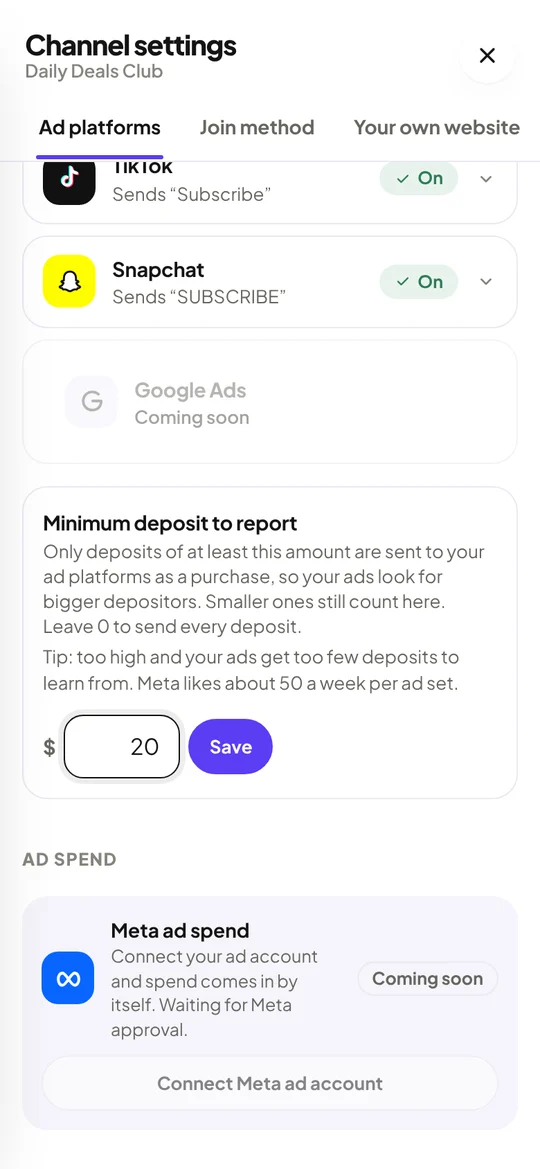
What happens after that:
| Deposit | In Joinvoo | Sent to Meta, TikTok, Snapchat |
|---|---|---|
| At or above your minimum | Counted | Yes, as a purchase with its value |
| Below your minimum | Counted | No. The log shows Under your minimum |
Your deposit counts, revenue and alerts don’t change. The minimum only decides what your ad platforms learn from. It’s set per channel, so a test channel and a scaling channel can have different minimums.
Deposit amount vs your commission
Here’s the other half. When your affiliate program sends a postback, the amount in it is usually the deposit: what the player paid. That’s exactly what Meta should get as the purchase value.
But the deposit isn’t what you earned. Your commission might be a $30 CPA, or 25% of net revenue, or a mix. If Joinvoo counted the deposit as your earnings, your profit report would look far better than reality.
There are two ways to get your real earnings into Joinvoo:
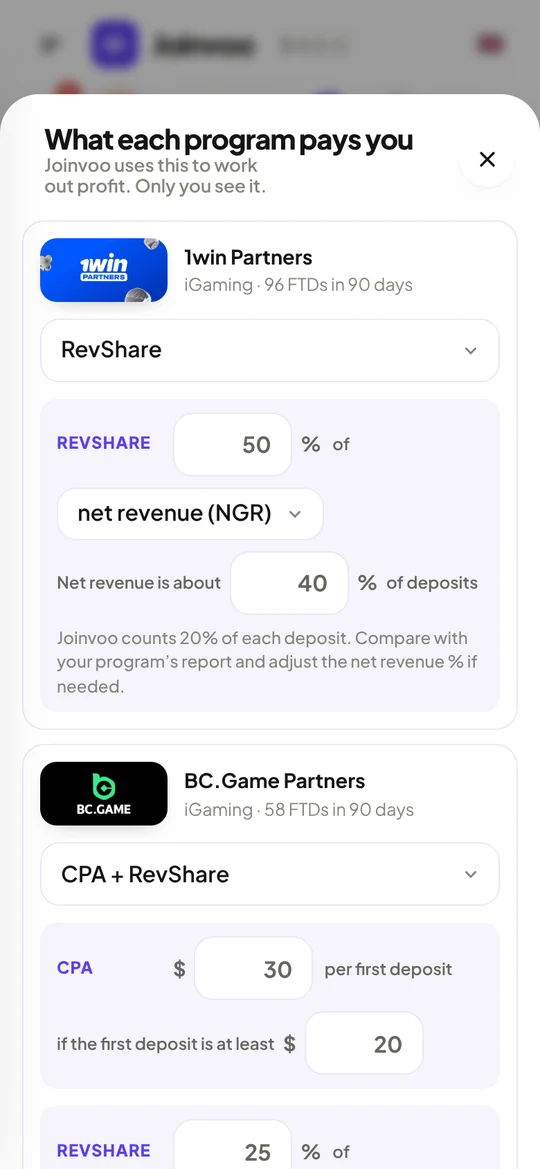
1. Tell Joinvoo what each program pays you. Open Results → Profit → Payouts and pick CPA, RevShare or both for each program. You can set a CPA that only counts above a minimum first deposit, and choose whether RevShare is on deposits or on net revenue (NGR).
2. Let the program send your real commission. If your program or tracker has a commission macro, add commission= to the postback next to the amount, using that macro. Joinvoo reads both:
…/pb/<your-key>?afftrack={afftrack}&status=ftd&amount={deposit}&commission={your_commission}The deposit amount still goes to Meta and your deposit reports. The commission becomes what Profit counts as earned. Leave the program’s payout on What the postback sends. A commission on a sign-up (a CPA paid on registration) counts too.
If you haven’t done either, the Profit page tells you: ”Right now ‘earned’ is the amount each postback sends, usually the deposit, so profit can look bigger than it is.”
The short version
- Leave Minimum deposit to report at 0 unless you have a reason. Set it near your CPA baseline once you have volume.
- The deposit goes to your ad platforms. Your commission goes to your profit report. Set your Payouts, or send
commission=in the postback, so you always know whether you’re really profitable.
New to deposit tracking? Start with Why Telegram deposit tracking works (and the one thing that breaks it).