When you have five ads, names don’t matter. You remember what everything is. When you have three platforms, a dozen campaigns and a few hundred ads across creative tests, names are the only thing standing between you and a spreadsheet nobody can read.
In a Telegram funnel this matters even more, because every join and deposit your tracker records carries the names that were on the ad at the moment of the click. If those names are a mess, every report built on them is a mess.
How names flow into your reports
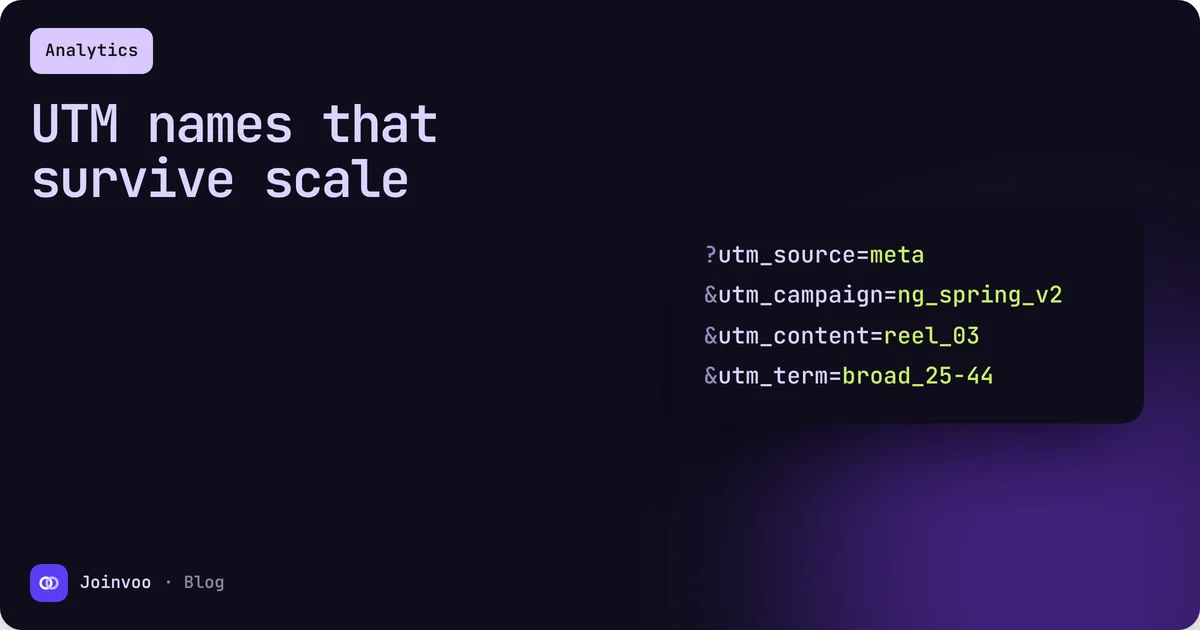
When you put dynamic parameters in your ad’s URL, the platform swaps in the real names at click time:
utm_campaign={{campaign.name}}&utm_term={{adset.name}}&utm_content={{ad.name}}That’s Meta’s syntax. TikTok and Snapchat have their own macros for the same idea; see TikTok ads to Telegram: the full setup and Snapchat ads for Telegram channels: a practical playbook. Your tracker stores those values with the click, and later with the join and any deposit. So the name of your ad at click time becomes a permanent label on that person.
Which means: if you want to compare all your video hooks, or all your lookalike audiences, or all your campaigns in one geo, the names have to make that possible.
The rules that matter
1. Fixed order
Every name follows the same sequence of tokens. If the geo is first in one campaign and third in another, you can’t sort or filter reliably.
2. One delimiter
Pick one separator and never use it inside a token. Underscore is a safe choice, since it survives URLs without encoding and reads cleanly. Avoid spaces, which become %20 or + in URLs and break splitting.
3. Lowercase, short, no special characters
broad not Broad Audience (new!). Short tokens keep names readable in narrow report columns and avoid encoding surprises.
4. A fixed vocabulary
Decide the allowed values for each token and write them down. lal, lookalike, LAL1 and lla should not all exist in the same account.
5. Version, don’t rename
When you change a creative meaningfully, give it a new version (v2). Don’t rename the old ad. Renaming rewrites history for every click that happens after the rename and splits your data in two.
A convention you can steal
Here’s a structure that works for most Telegram funnels. Adapt the tokens, keep the discipline.
Campaign: platform_geo_objective_offer_v
meta_geo1_subs_dealsch_v1
tt_geo2_ftd_appoffer_v3
Ad set: audience_placement_bid_v
broad_auto_lowcost_v1
lal2_reels_costcap_v2
int-fitness_feeds_lowcost_v1
Ad: format_concept_hook_v
vid_preview_hookA_v1
vid_preview_hookB_v1
img_listicle_hookA_v2
Notice what that makes possible. Want every hookB across all campaigns? Filter ads containing _hookB_. Want every geo2 campaign? Filter campaigns on the second token. Want to know whether preview videos beat listicle images? Group ads by the second token.
Keep a lookup table for the rest
Names should identify things, not describe them. When you’re tempted to cram the full hook text, the audience definition and the launch date into a name, stop. Put those in a simple sheet keyed by the name instead:
| Ad name | Hook text | Creator | Launched |
|---|---|---|---|
vid_preview_hookA_v1 | “This channel posts deals before anyone else” | in-house | week 1 |
vid_preview_hookB_v1 | “Stop paying full price for…” | in-house | week 1 |
Your reports stay readable. Your notes stay complete.
Names vs IDs
Every platform also offers ID macros (campaign ID, ad set ID, ad ID). IDs never change, even if someone renames an ad, which makes them the most reliable join key. Names are what humans read.
The best of both: send names in your UTMs for readable reports, and keep a way to map IDs to names (most ad platforms’ exports include both). If a report ever looks odd after someone renamed something mid-flight, IDs are how you untangle it.
Matching spend to results
Here’s where naming pays for itself. To calculate cost per join, cost per FTD and ROAS by campaign, your tracker needs to line up spend (from the ad platform) with results (joins and deposits from your tracker). The easiest key is the campaign name.
In Joinvoo’s ad spend view, you add spend per campaign, or import it as a CSV export from your ads manager, using the same campaign names as your UTMs. If the names match exactly, breakdowns light up. If someone wrote Meta_Geo1_Subs in one place and meta_geo1_subs in the other, they won’t. Consistency is the whole game. We cover the metrics themselves in Reading your numbers: ROAS, CPL and FTD rate without fooling yourself.
Rolling it out to a team
A naming convention fails the first time someone is in a hurry. A few habits help:
- Write it down in one place with examples, and link it in your team chat.
- Use templates. Duplicate a correctly named campaign instead of starting fresh.
- Review names during launch checks, the same way you check budgets and links.
- Fix mistakes fast. If a wrong name went live, duplicate with the right name and pause the wrong one, rather than renaming it.
Recap
Fixed order, one delimiter, lowercase, fixed vocabulary, versions instead of renames. Dynamic macros in the URL so every join and deposit carries its campaign, ad set and ad. A lookup sheet for everything else.
Set up your tracking link with the right URL parameters using the setup guide, or start free and see every join labelled with the ad that drove it.